Refillable programmes rarely go over budget because the unit price was wrong. They go over budget because the scope was never fixed. Filling, decoration, packaging, refill instructions, shelf presentation and the evidence behind the sustainability claim are all separate pieces of work, and the assumption that they sit inside the manufacturing quotation is the single most expensive assumption a retailer's own brand can make. A written scope checklist, agreed before sampling, is the cheapest control available.
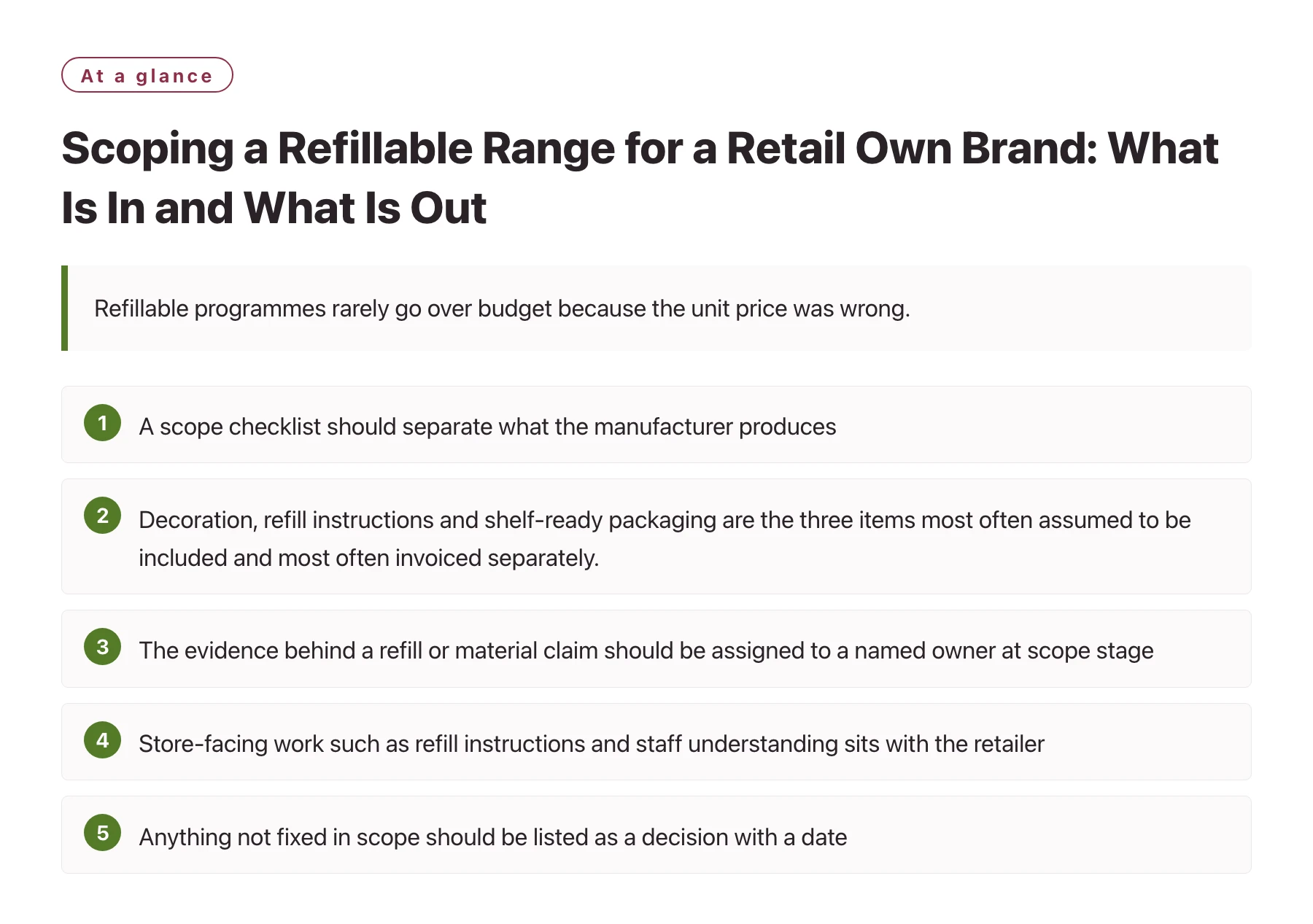
Key takeawaysA scope checklist should separate what the manufacturer produces, what the retailer supplies and what neither party has yet decided. · Decoration, refill instructions and shelf-ready packaging are the three items most often assumed to be included and most often invoiced separately. · The evidence behind a refill or material claim should be assigned to a named owner at scope stage, not at launch. · Store-facing work such as refill instructions and staff understanding sits with the retailer, and it takes longer than most teams plan for. · Anything not fixed in scope should be listed as a decision with a date, because an open scope item behaves like an unpriced change order.
Scope creep in a refill programme is quiet. Nobody adds a whole new product; they add a second refill format, a carton change, an extra market's label wording, a display unit for one store cluster. Each addition is defensible and each one moves cost and time.
This checklist is written for the product development lead inside a retail business, the person who has to explain to buying why the programme moved. Its purpose is to make the boundary visible before the first sample is approved.
Why scope decides the outcome more than price does
Two quotations for the same refillable range can differ by a wide margin without either being wrong, because they are pricing different scopes. One includes decoration and cartons; the other assumes the retailer sources them. One treats refill instructions as copy supplied by the customer; the other develops them. One includes the material calculation behind the claim; the other does not.
The reason this matters more than in a single-use programme is that a refill product has more parts that can move independently. The container, the refill unit, the closure, the secondary pack and the in-store communication all have to agree with each other, and each one can be owned by a different party. A partner such as Xuelei fragrance house that develops scent, pack and filling together removes several of those seams, but it does not remove the need to name the boundary.
A useful habit is to write the scope in three columns rather than one: what the manufacturer does, what the retailer does, and what nobody has decided yet. The third column is the honest one, and it is where nearly all late cost originates.
A scope checklist for a refillable range
| Scope area | Usually with the manufacturer | Usually with the retailer | Why the boundary matters |
|---|---|---|---|
| Scent development | Brief interpretation, sampling, adaptation, stability work | Approval of the reference and the final fragrance direction | Development rounds are the most common source of unplanned cost |
| Refill container | Design input, tooling coordination, fit and seal validation | Brand design language, approval of the final geometry | Tooling changes after first shots are expensive and slow |
| Filling and sealing | Compounding, resting, filling, crimping or pump closing | Approval of the bulk and release decision | The release decision cannot be delegated even when the checks are |
| Decoration and secondary pack | Print, label, carton specification and first-article approval | Artwork, copy, legal text and the market-specific wording | Legal text is a retailer responsibility in most own-brand programmes |
| Refill instructions | Technical dosage and handling information | Shopper-facing wording, translation and store communication | Instructions are part of the claim and part of the safety case |
| Evidence for the claim | Material data, pack weight and design basis | Substantiation file, claim wording and market review | Reuse and reduction claims need a documented basis [1] |
Read the table as a contract annex rather than a diagram. Any row where both columns are blank is a decision waiting to become a change order.
Three scope decisions that get postponed
Most programmes postpone the same three questions, and the postponement is always rational at the time.
How much of the range is genuinely refillable
Making one size refillable and the rest single-use is a legitimate strategy and it changes the whole scope. It reduces tooling, simplifies the shelf story and keeps the refill proposition legible to shoppers. The decision should be made before the container is designed for the full range, because reversing it later means paying for tooling that will not be used. A partner offering full ODM fragrance service will normally be able to model both routes; the choice still belongs to the retailer.
Whether the refill is sold in store or online
The channel changes the pack, not only the marketing. In-store refill needs a package that survives handling and communicates the dose quickly; an online refill needs transit protection and returns handling. Deciding this at scope stage keeps the pack specification from being rewritten after first article approval.
Who explains the refill to store staff
Refill formats live or die at the shelf, and the person explaining the mechanism is usually a store colleague with thirty seconds to spare. Writing that explanation is retail work, and it benefits from the same rigour as the product copy. Programmes that invest in professional scent training for store teams, including the refill mechanic itself, tend to report fewer handling complaints in the first season.
Where a programme involves a luxury or gift-oriented presentation, the same logic applies at a higher standard. fine fragrance manufacturing brings its own expectations about pack feel and finish, and scope items such as tissue, outer carton and unboxing sequence should be listed explicitly rather than assumed from a reference product.
Test any scope with one question: if this item is missing on the day the containers arrive, who pays and who is late? If the answer is unclear, the item is not yet in scope, it is only in the conversation.
Sources
- European Commission: Packaging Waste and the PPWR —— EU rules on packaging and packaging waste, including the Packaging and Packaging Waste Regulation requirements on recyclability and design.
Frequently asked questions
What should a refillable packaging scope document contain?
At minimum: the fragrance scope, the container and refill unit scope, filling and sealing, decoration and secondary packaging, shopper instructions, the evidence behind any claim, and the approval points. Each item needs an owner on each side and a decision date, not only a description.
Is decoration normally included in a refill quotation?
It varies, which is exactly why it belongs in the checklist. Some manufacturers handle print and label in house; others coordinate a specialist decorator and pass the cost through. The scope document should say which model applies and who approves the first article.
Who writes the refill instructions?
The manufacturer supplies the technical content: dose, handling, materials and any safety information. The retailer owns the shopper-facing wording, the translation and the in-store explanation. Splitting it this way keeps the technical accuracy with the factory and the brand voice with the retailer.
How do we avoid scope creep once the programme starts?
Log every new request as a decision with a date and an owner, and quote the cost of the change before accepting it. Scope creep is usually not a discipline problem but an accounting one: if additions are never priced, they feel free.
Does a refill programme need a different supplier from a standard fragrance line?
Not necessarily, but the supplier needs container development capability alongside fragrance and filling capability. If those sit in three different companies, the retailer ends up coordinating fit, seal and compatibility, which is the hardest part of the programme to own from outside the factory.